


 |


| Quantity: | |
|---|---|


The JM-900 automated production line is engineered for the precision handling of complex RF coaxial cables. It executes a complete and continuous sequence of operations, smoothly integrating rotary stripping, crimp wire buckle attachment, braid folding, stripping wire core, terminals crimping, and crimp outer contact assembly. Operators will notice the distinct, rhythmic mechanical movements and the quiet hum of the drive systems, reflecting the solid build and meticulous engineering of the machinery. This equipment is designed to eliminate manual handling variables, ensuring that every cut and crimp meets exact specifications for demanding automotive and telecommunications environments.
The JM-900 Fakra machine line is primarily utilized for processing RF cables with an exceptional level of automation and stringent product quality control, significantly reducing reliance on manual labor. By automating the intricate steps of wire preparation, facilities can achieve a rapid processing cycle of approximately 6 seconds per piece. This heightened efficiency directly translates to improved production capacity and a measurable return on investment. The system comprehensively handles the processing and inspection of the wire jacket, shield net, foil, inner conductor, and outer conductor. Every mechanical action, from the sharp, clean slice of the rotary blades to the firm, secure compression of the crimping modules, is calibrated to prevent material deformation. The heavy-duty steel frame absorbs operational vibrations, maintaining a stable platform that guarantees consistent output even during continuous, high-volume manufacturing shifts.
Equipped with a full servo driving system, the main bus cable utilizes a Mitsubishi controller paired with fiber cable communication. This configuration ensures rapid signal transmission and stable performance under heavy workloads. The inclusion of a Mitsubishi GT2000 touch screen provides an intuitive interface for operators, with optional mobile tablet communication facilitating convenient single-station debugging and immediate parameter adjustments.

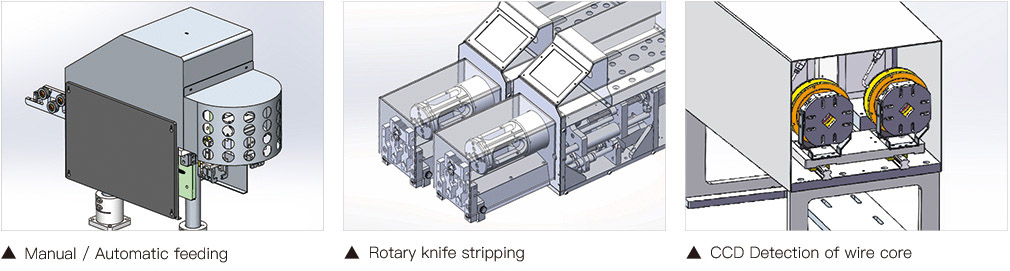
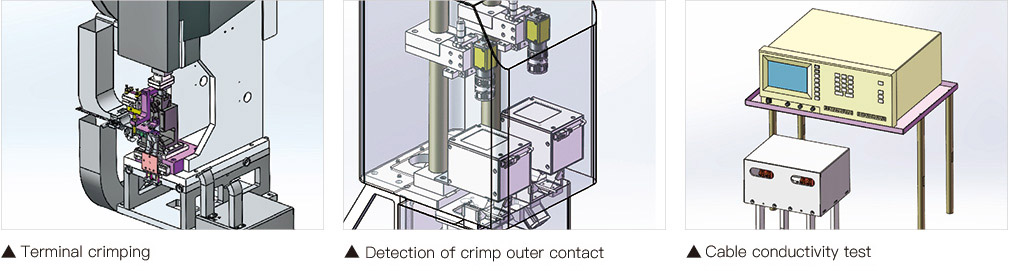
To maintain strict tolerances, the line relies on Keyence displacement sensors and Cognex camera detection systems to verify processing accuracy at a microscopic level. Furthermore, the machine is installed with an OES system to continuously monitor the crimping force during production. This multi-layered detection framework—covering wire overload, pressing errors, and terminal presence—achieves a rigorous quality control standard from the initial stripping phase to the final crimp.
The built-in formula database system enables storage and one-key switching of production profiles, perfectly accommodating various specifications such as Fakra Z, A, and B types. It features strict operation authority management and comprehensive product data tracking, fulfilling the exact traceability requirements of automotive industry standards like IATF 16949.
This equipment is widely deployed in the automatic processing of Fakra wire harnesses. Its precision engineering makes it indispensable for manufacturing high-frequency signal transmission cables used in vehicle communication, GPS navigation, autonomous driving sensors, remote diagnosis modules, audio equipment, and broadcast antennas.

Model | JM-900 FAKRA/Ethernet automated production line |
Capacity | Approx. 6s/pcs (at shortest cut) |
Wire range | 2.5–3.5mm2 coaxial cable |
Cutting length | 100mm–5000mm |
Stripping length | 0–20mm |
Cutting precision | ±0.5%xL |
Crimp force | 4T servo crimping machine x4 units |
Detecting device | Low pressure,wire detection,wire overload detection,pressing error,presence of terminals and overload detection. |
Control | PLC |
Power supply | AC380V 50/60Hz three-phase |
Temperature | 5°C – inner 50°C |
Humidity | 30%–80%RH (no condensation) |
Size | L12500 × W2260 × H1965mm |
Weight | 10T |

The physical construction of the JM-900 reflects a commitment to industrial endurance. The heavy-duty 10-ton chassis provides an exceptionally stable foundation, neutralizing the micro-vibrations generated by the four 4T servo crimping units. Operators interacting with the machine will note the smooth, polished finish of the tooling fixtures, which are precision-machined to prevent any scratching or abrasion on the sensitive RF coaxial cables. The layout of the workstations is ergonomically designed, allowing clear visibility into the processing zones while maintaining strict safety barriers. Every pneumatic line and electrical conduit is neatly routed and secured, minimizing wear and facilitating straightforward maintenance access. The tactile feedback of the access panels and the secure latching mechanisms further demonstrate the meticulous assembly of this production line.
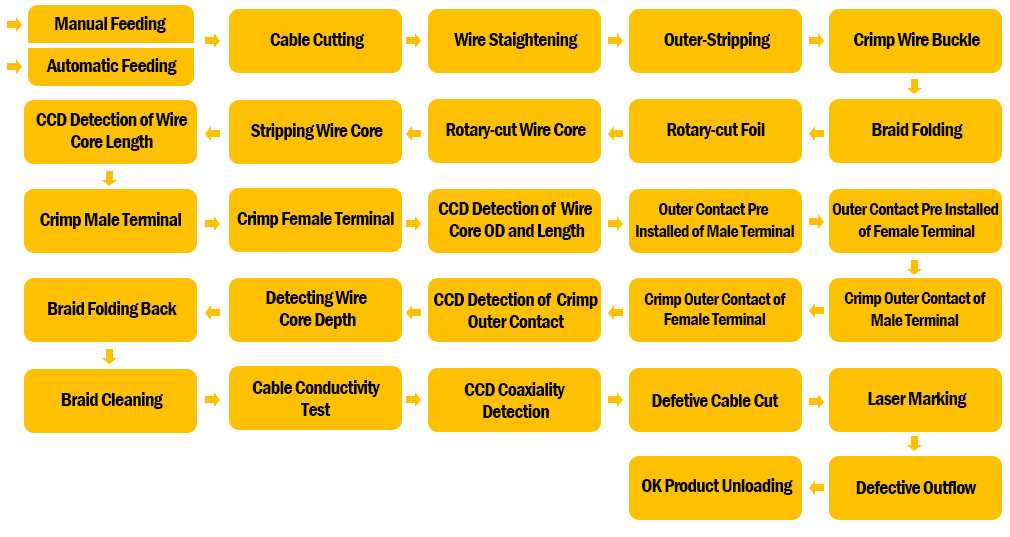
The operational sequence of the JM-900 is a masterclass in synchronized mechanical engineering. The process begins with the precise feeding and measuring of the 2.5–3.5mm2 coaxial cable, ensuring exact cut lengths ranging from 100mm to 5000mm. Following the initial cut, the rotary blades engage to strip the outer jacket with a clean, burr-free motion, exposing the shield net. The system then automatically folds the braid and strips the inner dielectric core without scoring the delicate inner conductor. Subsequently, the terminals are fed and positioned with pinpoint accuracy before the 4T servo presses execute the crimp. The entire sequence is continuously monitored by the integrated CCD visual inspection and conductivity testing modules, ensuring that each completed segment meets exact electrical and mechanical specifications before exiting the line.

The final output produced by the JM-900 speaks directly to its precision capabilities. The completed Fakra wire harnesses exhibit perfectly uniform crimps, with the outer contact securely anchoring the braided shield without compromising the structural integrity of the cable. Visual inspection of the samples reveals clean, sharp edges at the stripping points, free from frayed wires or deformed insulation. The terminals are aligned with exact concentricity, ensuring optimal mating cycles and reliable high-frequency signal transmission. These pristine physical characteristics are crucial for maintaining impedance stability and minimizing signal loss in demanding applications such as autonomous driving sensors and remote diagnostic systems.
Integrating a highly automated system like the JM-900 into an existing manufacturing facility requires expert guidance. We provide end-to-end technical support tailored to specific production environments. This encompasses comprehensive capacity evaluations to ensure the equipment aligns with projected output targets. Our engineering team specializes in the customization of tooling and fixtures, adapting the machinery to handle unique connector geometries or proprietary cable specifications. Furthermore, we offer extensive on-site or remote debugging services, ensuring that the single-station setup and formula database configurations are optimized for immediate deployment. This dedicated support structure guarantees that the equipment operates at peak efficiency, minimizing downtime and accelerating the transition to full-scale automated production.


